


.avif)
Where the practical and emotional meet in a conversation about life and death
Susanne LJ Westergren and Barbro Ohlson Smith come from completely different backgrounds but have found a common passion in opening up conversations about life's last journey. Where Susanne, with a, Barbro. Together they have created a platform where their complementary perspectives can meet and enrich each other.
Susanne: Think more about death and enjoy life
With a background as a nurse, and with experiences in hospice and emergency departments, Susanne has been close to both the beginning and the end of her life early on. In the middle of her life, she chose to train as a journalist with a focus on science and health. When she herself suffered bereavement in the family, she felt that she lacked both the knowledge and practical tools to deal with all that comes with death and grief. From that experience, the book grew The Art of Caring for an Estate ahead, and then the TV show on SVT Todo estado, in which the complex and often emotionally charged situations arising from a succession are portrayed.
For Susanne, practicality often becomes a way into the difficult, sorting, structuring and arranging. At the same time, she describes how she needs and longs to face the emotional deeper, and how order can sometimes become a refuge.
“For me, there is a spirituality that always accompanies every existence. I can see a soul in something as small as a bumblebee, and I carry care for every life, no matter how small,” after all, we are all part of a huge whole.”
Barbro: Designing the end
Barbro Ohlson Smith has a long background as a designer with a focus on identity and expression. Quando ha iniziato il podcast My death, my funeral it was to explore whether the same ideas about form and form could be applied to the end of life. She saw how many funerals followed a template and wondered if it was possible to create more personal farewells.
For more than fifty podcasts, Barbro.
“It has changed the way I look at the meaning of life and made me even more value living in the present, being present and taking advantage of relationships,” says Barbro about working on the podcast. Huh, and
The meeting point: the YouTube channel
When Susanne and Barbro found each other, a common idea emerged: to create a new forum where their different perspectives could meet. The result was a series on YouTube; How does it work - death, life and grief, which has recently been launched. vi. Also, how we can plan for the inevitable death of our own and those of our relatives is a topic that will be included in their productions.
Fact that they choose to broaden their collaboration with YouTube is because they want to reach out to younger generations. Moving media offers new possibilities for purely practical demonstration of how things work and not just tell about it. He, Jocke Wiik, sound engineer and film,.
Together they want to make it easier for us as a society to talk about death; not to set rules, but to dare to reflect, share experiences and perhaps find new ways to value life.
Ahead: more forums for talks
Both Susanne and Barbro see a continued need to create space for existential conversations. Through podcasts, books and now also the video format, they find different ways to reach out to more people. Needed for forums that open up conversations about death remains and Susanne and Barbro are far from finished.
Listen to Barbro's podcast My death, my funeral Aqui
Win YouTube Channel How does it work - death, life and grief Aqui
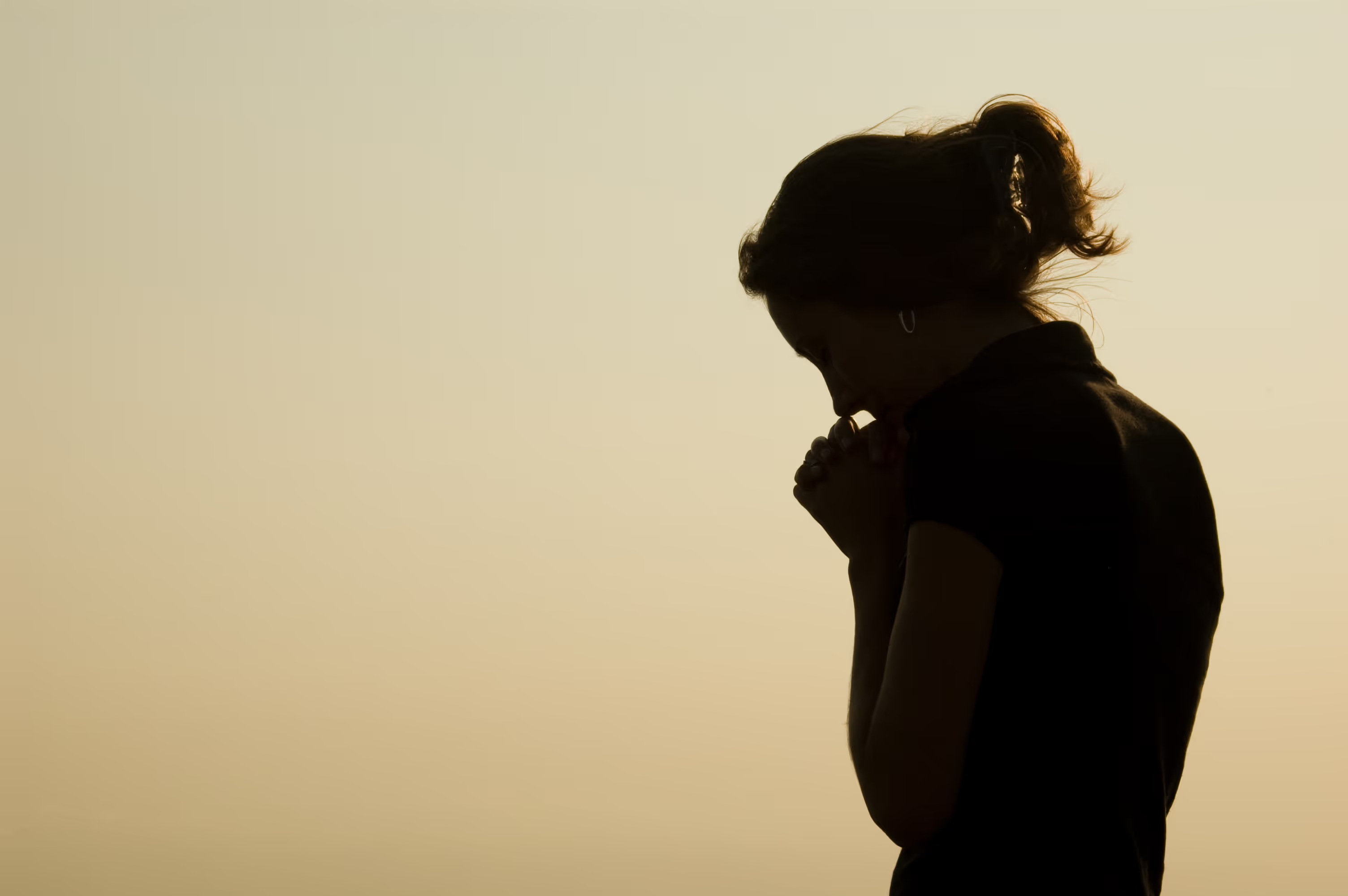
About Death Anxiety
What is death anxiety?
Death anxiety consists of a strong fear of one's own or another's death and its consequences. What constitutes the basic fear can vary from person to person. For some, it may be the grief of losing someone, for others the uncertainty of what happens after death can trigger anxiety.
If you yourself or someone in your life is seriously ill, it is a natural reaction to think about death and its consequences. Being afraid of death is therefore not a psychiatric diagnosis but a normal reaction to the realization that life is finite. But if your thoughts about death take up so much space that they limit your everyday life, such as at work or in your relationships, they pose a problem. Then it may be wise to either investigate what this fear and these thoughts are due to, or try to replace them with other, more helpful, thoughts and behaviors.
It is also not uncommon for death anxiety to occur in combination with other mental illness such as depression, generalized anxiety disorder (GAD), health anxiety, post-traumatic stress disorder (PTSD), or stress-related mental illness. For this, psychological treatment may be required.
Symptoms of Death Anxiety
Since death anxiety itself does not constitute a diagnosis, there is also no list of symptoms. However, here are some examples of reactions that are common in death anxiety:
- Bodily Experiences: Anxiety manifests itself in the body in many different ways such as heart palpitations, increased heart rate, tension, pressure on the breasts, lump in the throat and feelings of panic.
- Feelings: In addition to fear and anxiety, emotions such as anger, sadness, sadness, guilt and shame are also common.
- Thoughts: The fear of death can lead to a preoccupation with thoughts and one can easily fall into a stupor. Questions that concern “why” and “how” can occupy significant time and energy.
- Behaviors: Death anxiety can lead to avoidance of things dealing with death or avoidance of existential issues at large. Other behaviors may be linked to health, such as living life in an excessively healthy way.
Why do you get death anxiety?
Death is in its essence arcane and abstract, and at the same time something that we know for sure will befall us. Therefore, it is not at all strange that we humans from time to time come into contact with strong emotions when we think about the end of life. The function of death anxiety can be multi-bottomed.
From an evolutionary perspective, this fear is essential to our survival. It allows us to avoid dangers that could otherwise lead to our death, such as being alert in traffic. Other personal factors may include having experienced a painful death or a near-death experience of your own. How one views death in one's immediate family, as well as in the cultural and religious context one lives in, also influences how one perceives death. If you see death as something dangerous, secret or distressing, it's no wonder to develop anxiety. Likewise, a perception of death as, for example, the possibility of another life, can be a protective factor for the development of death anxiety.
How do you deal with death anxiety?
Here's some advice on how to deal with your death anxiety.
- Learn more about your anxiety. Examine your thoughts, feelings, bodily experiences, and behaviors in order to become more aware of how the fear of death affects you.
- Share your experiences with someone with whom you are safe. Curiously researching and processing these thoughts and feelings together with someone else can also be a good idea. Often a close friend or relative can help with new perspectives and reduce the experience of being alone in one's fear. It can also be helpful to converse with a priest or deacon as death forms a central theme in their profession.
- Examine what is important in life. Consider what is important in your life and how this can be expressed in the form of concrete actions. As with much else, anxiety has two sides. The other side of the coin is that death anxiety can motivate you to live life: Death forms the dark backdrop that gives life color. Knowing death can take us from a state of pondering why We live to ask ourselves instead how we want to live.
- “The three pillars”: To reduce your vulnerability to anxiety, it's important to make sure you have a good sleep routine, get enough nutrition, and exercise regularly.
Treatment for death anxiety
Unpleasant thoughts about death something that most people experience from time to time. Death anxiety cannot be cured, because it is not a disease. However, if you suffer so much that it affects you in your everyday life or at the same time suffer from another mental illness, it may be appropriate to seek help.
If you want to get in touch with a psychologist who works with death anxiety, you can book a visit directly to Mindler.