


The meaning of life

About Quality of Life
Having a stable financial situation and maintaining your health. Being in balance both physically and mentally. Laughing often and having kind people around you. Feeling that your life is generally good and doesn’t make you want to escape to a deserted island. These are some ideas of what quality of life can be.
From an academic perspective, quality of life is defined as a person’s subjective experience of their own well-being in relation to their life conditions. What quality of life actually means can vary between individuals and is influenced by factors such as environment, circumstances, and values. Because these aspects differ significantly from person to person, quality of life often becomes a philosophical question. The discussion can range from the most basic human needs to how we achieve self-actualization.
In societies where human rights are established and where strong social structures exist, conversations often revolve around how we can relax, enjoy life, and fulfill our dreams. However, many would generally agree that a good quality of life is characterized by a harmonious balance between physical, mental, economic, and social factors.
Quality of life is not static; it changes along with you and the society you live in. Today, we also encounter new types of factors that influence quality of life compared to the past. Work and leisure are increasingly intertwined, technology plays a major and central role in our lives, and social aspects have taken on new forms of distribution. All of this has both positive and negative effects. Therefore, the definition of quality of life is both fluid and constantly evolving.
It is thus a complex subject that touches on both individual and societal aspects. By understanding what affects it, we can improve our own quality of life and contribute to a better living environment for others.
Quality of life in healthcare
Quality of life is at the heart of healthcare. It is a very important aspect of treatment and care. It is, of course, important that a patient overcomes illness or receives the correct medical treatment, but how the individual’s daily life and well-being are affected by care is equally important. Quality of life in healthcare is therefore not only about curing diseases, but also about ensuring that patients can live as well and as independently as possible despite any health issues.
To safeguard quality of life in healthcare, the following are often prioritized:
- Access to fast and equitable care
- Maintaining high standards in pain management and symptom relief
- Providing psychological support to manage anxiety, depression, and other mental health challenges
- Encouraging patient participation in their care plan so they can have a say in the treatment they receive
- Palliative care – supportive care when a disease is incurable
Reduced quality of life
When life is marked by friction, or when a particular aspect becomes unbalanced, it can lead to a perceived decline in quality of life. For example, long-term stress, financial insecurity, social isolation, or chronic health problems can negatively affect a person’s well-being. People often feel that this limits their ability to do or achieve what they want. It can also mean restricted routines, a lack of routines, or a sense of losing control over one’s life.
To improve quality of life, it can therefore be important to identify and work on the areas that create imbalance—such as through support from healthcare services, social networks, or changes in lifestyle and daily habits.
If you would like to get in touch with a psychologist for professional help, you can make an appointment directly at Mindler.
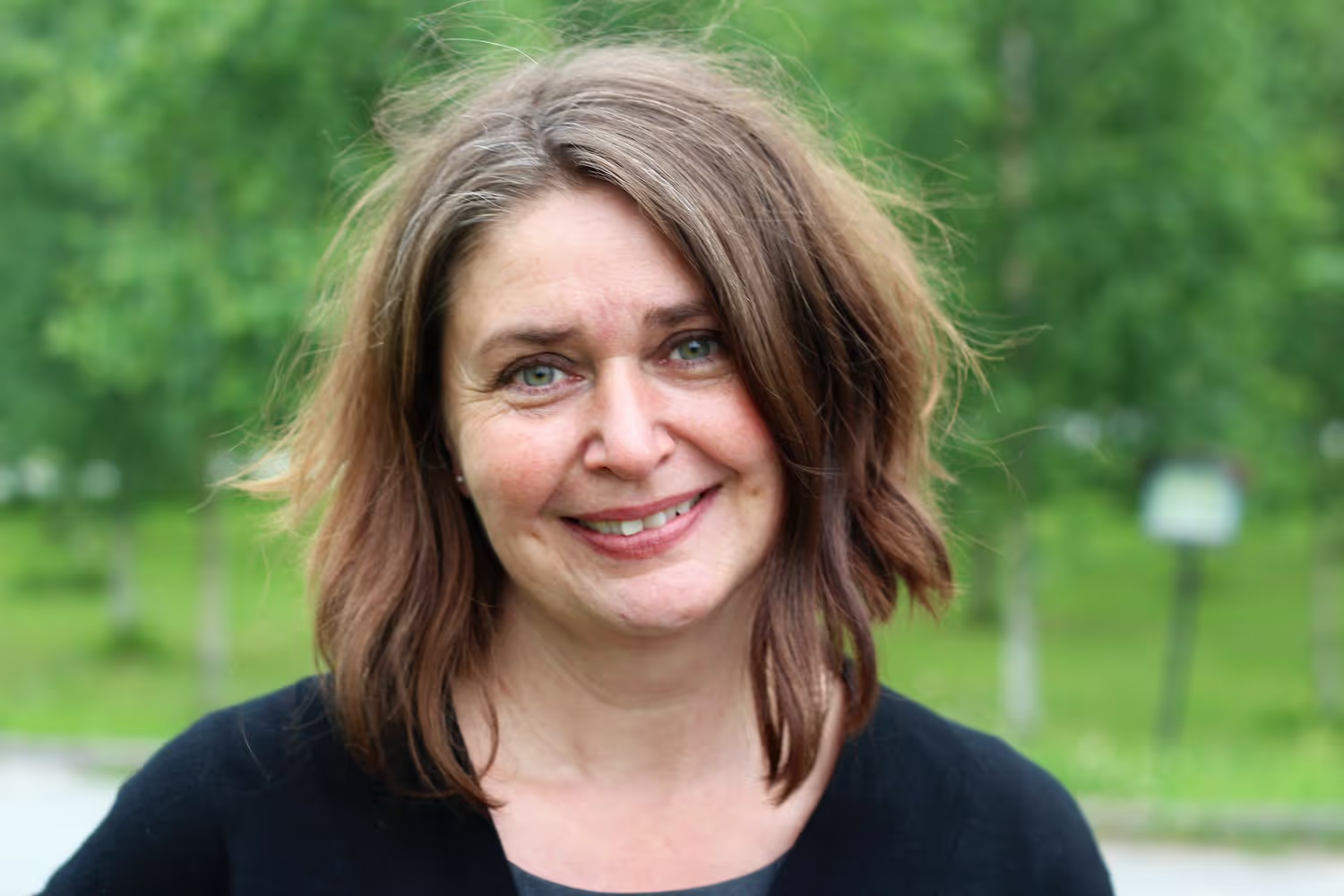
Living near death: a conversation with Katarina Blix Lundqvist
For Katarina Blix Lundqvist, the most beautiful thing about her work is to meet people in the middle of life, and in the midst of grief. As an officiant and singer, she leads funerals with both warmth and presence, describing it as one of the funniest and most meaningful parts of her life.
“I'm curious about people's life stories. It is stimulating to create a great moment together with our loved ones, where we honor life for real.”
When life crumbled and something new began
Catherine's interest in death and the conversation about dying has been around for a long time, but it was in 2017 that it became deeply personal. In a short time, everything changed with both separation and death, and she herself fell into a great grief.
“I then took a course in grief processing through the Swedish Institute for Grief Processing. It became an important turning point. Then I went to further education, both for my own sake and to be able to be there for others.”
Since then Katarina has devoted herself to creating space for conversations about what is often difficult to put into words. She wants to help make death less taboo and grief more visible. One of the ways she does it is through Death Talk, safe rooms where people are allowed to gather to talk about death, life, fears, meaning and loss.
Support at the very last stage of life
As part of her commitment, Katarina has also trained as a certified Death Doula and End-of-Life Planner. In this role, she supports people who are in the final stages of life and their loved ones, through conversations, preparations and presence. Sometimes it's about planning for death in advance, sometimes it's about being there when the end nears. Whatever the situation, her focus is to contribute calm, structure and human warmth. The training was conducted at Going with Grace in Los Angeles, under the direction of Alua Arthur.
Facing Grief — With Singing and Presence
For Katarina, the work as an official is not just about words. It's just as much presence, silence, music, and daring to remain in it that chafes. She often sings by herself during the ceremonies, and uses her voice as a way to create closeness and feeling.
Katarina, a. “It's about keeping a warm and safe frame where people get to feel, remember and say goodbye in their own way.”

About Death Anxiety
What is death anxiety?
Death anxiety consists of a strong fear of one's own or another's death and its consequences. What constitutes the basic fear can vary from person to person. For some, it may be the grief of losing someone, for others the uncertainty of what happens after death can trigger anxiety.
If you yourself or someone in your life is seriously ill, it is a natural reaction to think about death and its consequences. Being afraid of death is therefore not a psychiatric diagnosis but a normal reaction to the realization that life is finite. But if your thoughts about death take up so much space that they limit your everyday life, such as at work or in your relationships, they pose a problem. Then it may be wise to either investigate what this fear and these thoughts are due to, or try to replace them with other, more helpful, thoughts and behaviors.
It is also not uncommon for death anxiety to occur in combination with other mental illness such as depression, generalized anxiety disorder (GAD), health anxiety, post-traumatic stress disorder (PTSD), or stress-related mental illness. For this, psychological treatment may be required.
Symptoms of Death Anxiety
Since death anxiety itself does not constitute a diagnosis, there is also no list of symptoms. However, here are some examples of reactions that are common in death anxiety:
- Bodily Experiences: Anxiety manifests itself in the body in many different ways such as heart palpitations, increased heart rate, tension, pressure on the breasts, lump in the throat and feelings of panic.
- Feelings: In addition to fear and anxiety, emotions such as anger, sadness, sadness, guilt and shame are also common.
- Thoughts: The fear of death can lead to a preoccupation with thoughts and one can easily fall into a stupor. Questions that concern “why” and “how” can occupy significant time and energy.
- Behaviors: Death anxiety can lead to avoidance of things dealing with death or avoidance of existential issues at large. Other behaviors may be linked to health, such as living life in an excessively healthy way.
Why do you get death anxiety?
Death is in its essence arcane and abstract, and at the same time something that we know for sure will befall us. Therefore, it is not at all strange that we humans from time to time come into contact with strong emotions when we think about the end of life. The function of death anxiety can be multi-bottomed.
From an evolutionary perspective, this fear is essential to our survival. It allows us to avoid dangers that could otherwise lead to our death, such as being alert in traffic. Other personal factors may include having experienced a painful death or a near-death experience of your own. How one views death in one's immediate family, as well as in the cultural and religious context one lives in, also influences how one perceives death. If you see death as something dangerous, secret or distressing, it's no wonder to develop anxiety. Likewise, a perception of death as, for example, the possibility of another life, can be a protective factor for the development of death anxiety.
How do you deal with death anxiety?
Here's some advice on how to deal with your death anxiety.
- Learn more about your anxiety. Examine your thoughts, feelings, bodily experiences, and behaviors in order to become more aware of how the fear of death affects you.
- Share your experiences with someone with whom you are safe. Curiously researching and processing these thoughts and feelings together with someone else can also be a good idea. Often a close friend or relative can help with new perspectives and reduce the experience of being alone in one's fear. It can also be helpful to converse with a priest or deacon as death forms a central theme in their profession.
- Examine what is important in life. Consider what is important in your life and how this can be expressed in the form of concrete actions. As with much else, anxiety has two sides. The other side of the coin is that death anxiety can motivate you to live life: Death forms the dark backdrop that gives life color. Knowing death can take us from a state of pondering why We live to ask ourselves instead how we want to live.
- “The three pillars”: To reduce your vulnerability to anxiety, it's important to make sure you have a good sleep routine, get enough nutrition, and exercise regularly.
Treatment for death anxiety
Unpleasant thoughts about death something that most people experience from time to time. Death anxiety cannot be cured, because it is not a disease. However, if you suffer so much that it affects you in your everyday life or at the same time suffer from another mental illness, it may be appropriate to seek help.
If you want to get in touch with a psychologist who works with death anxiety, you can book a visit directly to Mindler.