

.avif)
Where the practical and emotional meet in a conversation about life and death
Susanne LJ Westergren and Barbro Ohlson Smith come from completely different backgrounds but have found a common passion in opening up conversations about life's last journey. Where Susanne, with a, Barbro. Together they have created a platform where their complementary perspectives can meet and enrich each other.
Susanne: Think more about death and enjoy life
With a background as a nurse, and with experiences in hospice and emergency departments, Susanne has been close to both the beginning and the end of her life early on. In the middle of her life, she chose to train as a journalist with a focus on science and health. When she herself suffered bereavement in the family, she felt that she lacked both the knowledge and practical tools to deal with all that comes with death and grief. From that experience, the book grew The Art of Caring for an Estate ahead, and then the TV show on SVT Todo estado, in which the complex and often emotionally charged situations arising from a succession are portrayed.
For Susanne, practicality often becomes a way into the difficult, sorting, structuring and arranging. At the same time, she describes how she needs and longs to face the emotional deeper, and how order can sometimes become a refuge.
“For me, there is a spirituality that always accompanies every existence. I can see a soul in something as small as a bumblebee, and I carry care for every life, no matter how small,” after all, we are all part of a huge whole.”
Barbro: Designing the end
Barbro Ohlson Smith has a long background as a designer with a focus on identity and expression. Quando ha iniziato il podcast My death, my funeral it was to explore whether the same ideas about form and form could be applied to the end of life. She saw how many funerals followed a template and wondered if it was possible to create more personal farewells.
For more than fifty podcasts, Barbro.
“It has changed the way I look at the meaning of life and made me even more value living in the present, being present and taking advantage of relationships,” says Barbro about working on the podcast. Huh, and
The meeting point: the YouTube channel
When Susanne and Barbro found each other, a common idea emerged: to create a new forum where their different perspectives could meet. The result was a series on YouTube; How does it work - death, life and grief, which has recently been launched. vi. Also, how we can plan for the inevitable death of our own and those of our relatives is a topic that will be included in their productions.
Fact that they choose to broaden their collaboration with YouTube is because they want to reach out to younger generations. Moving media offers new possibilities for purely practical demonstration of how things work and not just tell about it. He, Jocke Wiik, sound engineer and film,.
Together they want to make it easier for us as a society to talk about death; not to set rules, but to dare to reflect, share experiences and perhaps find new ways to value life.
Ahead: more forums for talks
Both Susanne and Barbro see a continued need to create space for existential conversations. Through podcasts, books and now also the video format, they find different ways to reach out to more people. Needed for forums that open up conversations about death remains and Susanne and Barbro are far from finished.
Listen to Barbro's podcast My death, my funeral Aqui
Win YouTube Channel How does it work - death, life and grief Aqui
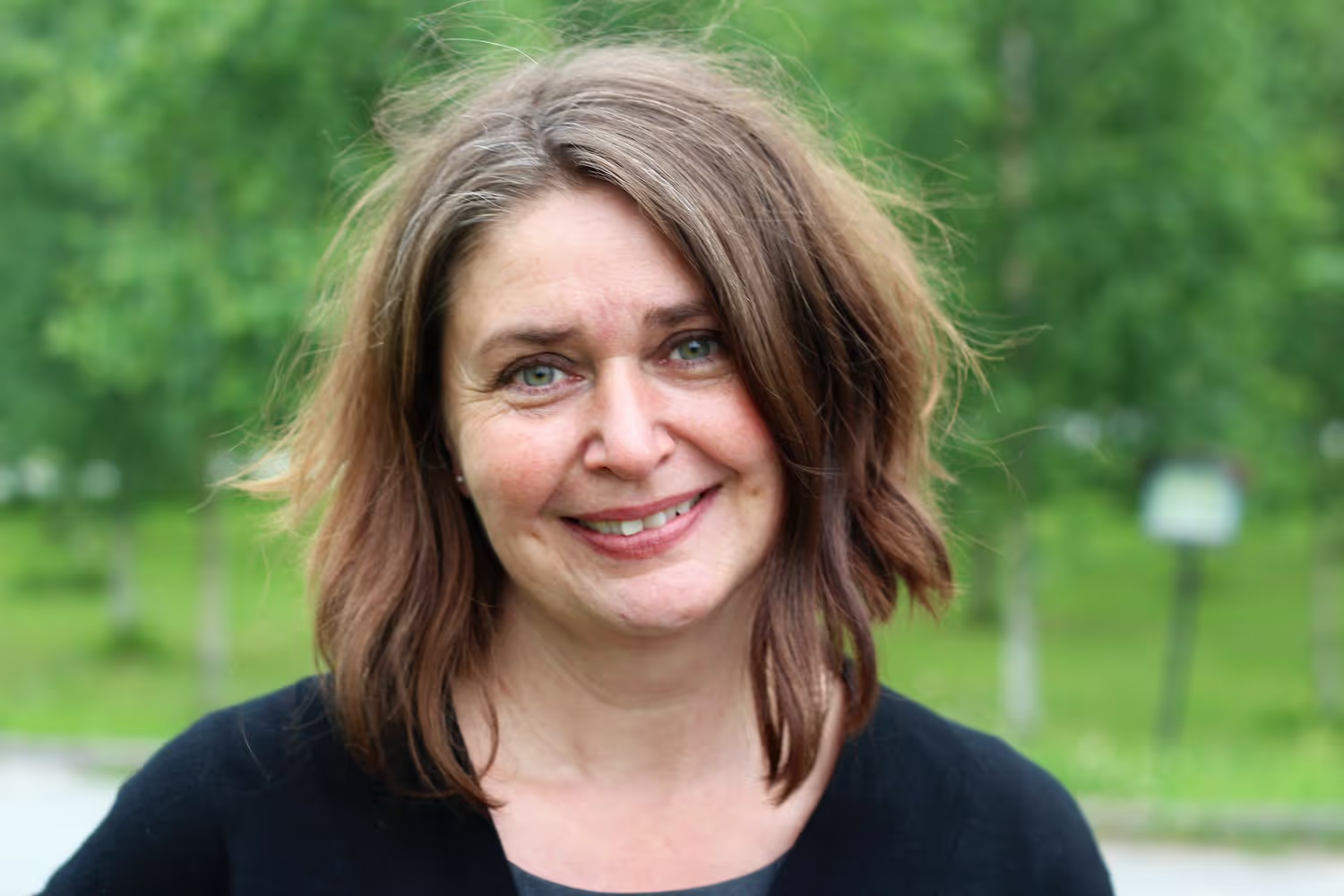
Living near death: a conversation with Katarina Blix Lundqvist
For Katarina Blix Lundqvist, the most beautiful thing about her work is to meet people in the middle of life, and in the midst of grief. As an officiant and singer, she leads funerals with both warmth and presence, describing it as one of the funniest and most meaningful parts of her life.
“I'm curious about people's life stories. It is stimulating to create a great moment together with our loved ones, where we honor life for real.”
When life crumbled and something new began
Catherine's interest in death and the conversation about dying has been around for a long time, but it was in 2017 that it became deeply personal. In a short time, everything changed with both separation and death, and she herself fell into a great grief.
“I then took a course in grief processing through the Swedish Institute for Grief Processing. It became an important turning point. Then I went to further education, both for my own sake and to be able to be there for others.”
Since then Katarina has devoted herself to creating space for conversations about what is often difficult to put into words. She wants to help make death less taboo and grief more visible. One of the ways she does it is through Death Talk, safe rooms where people are allowed to gather to talk about death, life, fears, meaning and loss.
Support at the very last stage of life
As part of her commitment, Katarina has also trained as a certified Death Doula and End-of-Life Planner. In this role, she supports people who are in the final stages of life and their loved ones, through conversations, preparations and presence. Sometimes it's about planning for death in advance, sometimes it's about being there when the end nears. Whatever the situation, her focus is to contribute calm, structure and human warmth. The training was conducted at Going with Grace in Los Angeles, under the direction of Alua Arthur.
Facing Grief — With Singing and Presence
For Katarina, the work as an official is not just about words. It's just as much presence, silence, music, and daring to remain in it that chafes. She often sings by herself during the ceremonies, and uses her voice as a way to create closeness and feeling.
Katarina, a. “It's about keeping a warm and safe frame where people get to feel, remember and say goodbye in their own way.”