


.avif)
Where the practical and emotional meet in a conversation about life and death
Susanne LJ Westergren and Barbro Ohlson Smith come from completely different backgrounds but have found a common passion in opening up conversations about life's last journey. Where Susanne, with a, Barbro. Together they have created a platform where their complementary perspectives can meet and enrich each other.
Susanne: Think more about death and enjoy life
With a background as a nurse, and with experiences in hospice and emergency departments, Susanne has been close to both the beginning and the end of her life early on. In the middle of her life, she chose to train as a journalist with a focus on science and health. When she herself suffered bereavement in the family, she felt that she lacked both the knowledge and practical tools to deal with all that comes with death and grief. From that experience, the book grew The Art of Caring for an Estate ahead, and then the TV show on SVT Todo estado, in which the complex and often emotionally charged situations arising from a succession are portrayed.
For Susanne, practicality often becomes a way into the difficult, sorting, structuring and arranging. At the same time, she describes how she needs and longs to face the emotional deeper, and how order can sometimes become a refuge.
“For me, there is a spirituality that always accompanies every existence. I can see a soul in something as small as a bumblebee, and I carry care for every life, no matter how small,” after all, we are all part of a huge whole.”
Barbro: Designing the end
Barbro Ohlson Smith has a long background as a designer with a focus on identity and expression. Quando ha iniziato il podcast My death, my funeral it was to explore whether the same ideas about form and form could be applied to the end of life. She saw how many funerals followed a template and wondered if it was possible to create more personal farewells.
For more than fifty podcasts, Barbro.
“It has changed the way I look at the meaning of life and made me even more value living in the present, being present and taking advantage of relationships,” says Barbro about working on the podcast. Huh, and
The meeting point: the YouTube channel
When Susanne and Barbro found each other, a common idea emerged: to create a new forum where their different perspectives could meet. The result was a series on YouTube; How does it work - death, life and grief, which has recently been launched. vi. Also, how we can plan for the inevitable death of our own and those of our relatives is a topic that will be included in their productions.
Fact that they choose to broaden their collaboration with YouTube is because they want to reach out to younger generations. Moving media offers new possibilities for purely practical demonstration of how things work and not just tell about it. He, Jocke Wiik, sound engineer and film,.
Together they want to make it easier for us as a society to talk about death; not to set rules, but to dare to reflect, share experiences and perhaps find new ways to value life.
Ahead: more forums for talks
Both Susanne and Barbro see a continued need to create space for existential conversations. Through podcasts, books and now also the video format, they find different ways to reach out to more people. Needed for forums that open up conversations about death remains and Susanne and Barbro are far from finished.
Listen to Barbro's podcast My death, my funeral Aqui
Win YouTube Channel How does it work - death, life and grief Aqui

Anna Christoffersson on the power of music in personal farewells
When someone passes away, a notion often arises that a funeral must follow fixed frameworks. But the parting can be as unique as the life that the person leaves behind. There is a great scope to shape ceremonies that reflect the person, the relationships and all that is carried on.
Today, more and more families seek farewells that feel close and meaningful, where the tone, the words and the place together create a memory to rest in. In the process, music has become a central companion. It expresses what may be hard to say, but easy to feel.
“I sometimes think of funerals as a kind of tribute concert,” says artist and officiant Anna Christoffersson and continues: “People's lives are worth highlighting. When we do something beautiful together, it becomes a gift to those who are left behind.”
Music — a common place to meet
Music can carry memories of a lifetime. It invites presence in a moment that often holds both missing and stillness, and it unites people with different experiences and feelings.
It is also something that many relatives testify to. A person who hired Anna put it this way:
“Experience from a funeral: Anna and her fellow musicians showed an incredibly good musical performance. I know that they are all famous musicians with great CVs, but at least I want to say that this was one of the best things I have experienced on such an occasion. Astonishing singing, lovely piano playing, what an amazing tone in the trumpet.. all so subtle and beautiful, couldn't get any better for our dear friend's funeral.“ Customer about Anna at Trustpilot
For many, music becomes a bridge between silence and what needs to be said, between grief and everything that lives on in the heart. Musique crire un movimento, una dirección y una seguridad para restar
From Grammy nominations to ceremonial work
Anna has lived with music throughout her professional life and is a multiple Grammy nominee in jazz. Quando è studiato come un attore funerale, la sua artistry took on a new dimension: creating experiences that provide support, warmth and meaning in one of life's most vulnerable moments.
“I have always created whole things, both concerts, events, ceremonies. In this work, music becomes a tool that makes a real difference for people.”
In meeting with families, she uses both her voice and her feeling to shape the context. Sometimes she leads the whole ceremony, sometimes she contributes solely to the music. The shape is always adapted to the person who passed away and to those who gather to remember.
Parting that feels personal and cohesive
A personal farewell is about more than music. It's about how the whole moment gets to shape the rhythm, the pauses, the stories and the presence.
Regardless of how the ceremony is set up, the goal is the same: to create a safe place where people are allowed to be together, without demands, with room for both tears and gratitude.
When a ceremony is thought out and shaped after the people attending, it can provide support long afterwards. When parting becomes personal, it often becomes a memory to hold on to, where the music helps to carry both the grief and all that is left to live on.

Rest in Peace — When Dignity Becomes the Last Expression of Care
When Victoria Wickman first came into contact with the work around the final afterlife, she saw something that touched her deeply. Despite a great deal of involvement in the industry, the care of the deceased was often characterized by procedures that were mechanical and lacked the care that people deserve, both in respect for the departed and for those who remain.
With a background as a political scientist and many years in the public sector, Victoria trained as an undertaker. During her internship, it became clear to her how much a dignified presentation of the body means to relatives. She describes herself as simple and human:
I don't want my relatives to see me in an undignified condition, and I don't want to leave them with that image. '
Her Company, Rest in Peace, is today is one of the few in Sweden offering advanced post-mortem cosmetics and reconstruction. By restoring damage and giving the body the most dignified appearance possible, Victoria creates the opportunity for relatives to say goodbye in a way that feels safe, respectful and healing.
Caring beyond the visible
For Victoria, the work isn't just about technology and cosmetics, it's about people's last impressions of someone they loved. In cases where injuries make it difficult to say goodbye, her contribution can be decisive in determining whether relatives dare and have the courage to take a personal farewell from the deceased, which can be crucial in grief processing.
She has seen how forgone goodbyes deepen grief, and how dignified care can provide comfort when everything else is heavy. Therefore, Victoria bears a clear motto:
“Everyone who wishes should be able to say a dignified farewell. Everyone deserves a dignified end.”
A Work Grounded in Respect
Resting in Peace is based on a value foundation where care, quality and discretion in every moment and all work is done by Victoria. In an industry where physical care after death often falls into the dark, Victoria has created a path that puts the human at the center, even when life is over.
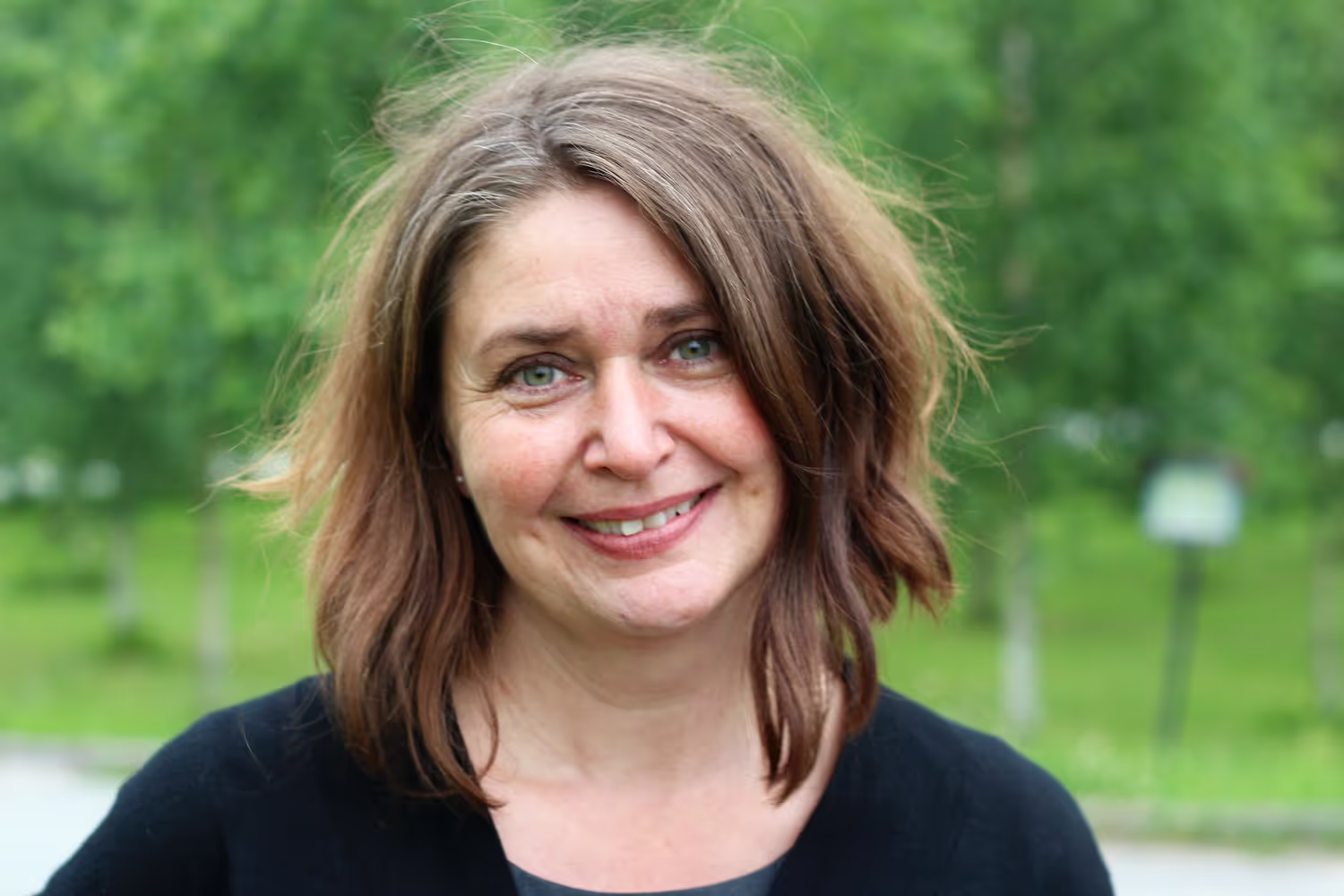
Living near death: a conversation with Katarina Blix Lundqvist
For Katarina Blix Lundqvist, the most beautiful thing about her work is to meet people in the middle of life, and in the midst of grief. As an officiant and singer, she leads funerals with both warmth and presence, describing it as one of the funniest and most meaningful parts of her life.
“I'm curious about people's life stories. It is stimulating to create a great moment together with our loved ones, where we honor life for real.”
When life crumbled and something new began
Catherine's interest in death and the conversation about dying has been around for a long time, but it was in 2017 that it became deeply personal. In a short time, everything changed with both separation and death, and she herself fell into a great grief.
“I then took a course in grief processing through the Swedish Institute for Grief Processing. It became an important turning point. Then I went to further education, both for my own sake and to be able to be there for others.”
Since then Katarina has devoted herself to creating space for conversations about what is often difficult to put into words. She wants to help make death less taboo and grief more visible. One of the ways she does it is through Death Talk, safe rooms where people are allowed to gather to talk about death, life, fears, meaning and loss.
Support at the very last stage of life
As part of her commitment, Katarina has also trained as a certified Death Doula and End-of-Life Planner. In this role, she supports people who are in the final stages of life and their loved ones, through conversations, preparations and presence. Sometimes it's about planning for death in advance, sometimes it's about being there when the end nears. Whatever the situation, her focus is to contribute calm, structure and human warmth. The training was conducted at Going with Grace in Los Angeles, under the direction of Alua Arthur.
Facing Grief — With Singing and Presence
For Katarina, the work as an official is not just about words. It's just as much presence, silence, music, and daring to remain in it that chafes. She often sings by herself during the ceremonies, and uses her voice as a way to create closeness and feeling.
Katarina, a. “It's about keeping a warm and safe frame where people get to feel, remember and say goodbye in their own way.”

About Unprocessed Grief
What is sadness?
Most of us experience sadness at some point in the course of our lives. Grief is an emotional reaction to loss or great change. We grieve because we take in the loss we suffered and try to understand and adapt to a new life situation. Grief helps us with this, but also serves as a signal to the outside world that we need comfort and support.
A grief reaction can be triggered in response to various types of losses, such as:
- fatality
- Separaciones
- Losing a job or unemployment
- Different forms of abuse
- Ogni o altri persone
- Children moving away from home
- Pets passing away
- To retire
- A future that didn't turn out as expected
How does grief feel?
Grieving is often a more comprehensive experience than just being sad. Grief manifests itself in different ways for different people and can include a range of emotions such as sadness, anger, guilt, shame, confusion and emptiness. Grief can also contain conflicting thoughts and feelings, for example, it is not uncommon to feel both sadness and relief when someone who suffered from a severe illness passes away. How grief feels is individual, and it's important to remember that there is no “right” way to grieve.
Being in a new life situation can be extremely stressful, while the world around you is living as usual. The gap here can be extremely large. It is not uncommon to experience in grief a mixture of physical, emotional, thought and behavioral reactions, such as:
- A feeling of being numb
- Mood Swings
- Concentration and memory difficulties
- Feelings of unreality
- Changing eating habits
- Lack of energy
- Feelings of emptiness, loneliness, meaninglessness
- Missing and longing
- Re-Experiences of What Happened
- Difficulty sleeping
- Self-incrimination and the Quandary of Conscience
- Anxiety and emotional vulnerability
- Irritability, anger, or aggressiveness
- Passivity
- Impaired immune system
- Fainting or feeling sick
- Social isolation
- Lack of initiative
- Weeping mildness
- Difficulty adapting to change
- Increased alcohol intake
How is grief processed?
It can be very demanding to take in the pain of a great loss. Sometimes the expression is used bereavement work. New research shows that there is no definite way to process grief. For a person, a solo time with his interest is necessary, but for another, conversations with friends can be necessary. You just have to approach grief in your own way. The important thing is to find what helps you move on from the loss.
Phases of grief
In the past, we talked more about the different phases of grief, such as the shock phase, the reaction phase, the processing phase and the new orientation phase. See,. It is common to first experience a state of shock when faced with a life-changing event. Some may feel like they are in a nightmare they hope to wake up from. In addition, over time, one can integrate the event into one's life. This does not mean that the pain has disappeared, but that you have reached a form of emotional acceptance and can begin to move forward in life.
Bubbles of grief
Instead of different phases, we can talk about different bubbles. You can move between a bubble of grief and a bubble where life feels like normal. When you're in the grief bubble, only the grief exists and the reality feels unreal. Sie in the second bubble you can see confusend a creëren a guilty conscience. It seems important that it is completely normal to help between bubbles, it is difficult. Amount of time one is in the various bubbles will change during the grieving process.
A grieving process takes a different amount of time for different individuals and for different losses. For some people, the grief can be intense and last for months or even years. Others can reach acceptance and relief relatively quickly. It is also normal for grief to return even though you feel that you have grieved clearly.
Coping with grief
From a psychological perspective, it is good to allow oneself to feel one's sadness and express the thoughts and feelings that arise. This can be done by writing down your feelings, and finding meaningful ways to remember what has been lost. På,, a a a a a a.
Grief Management Tools
You who are experiencing grief can do this:
- Allow yourself to feel your grief fully.
- Express what is going on inside you. Tell, write or paint.
- Seek support from friends and relatives.
- Take care of yourself with exercise, sleep and diet.
- Maintain, to the extent possible, your usual routines. It can be hard to understand in grief why we should even do anything. But routines become counterbalance to the confusion and a rest from the difficult.
- Seek the support of other mourners, for example via the church's grief group.
- If you need professional support, you can apply to a curator or deacon for support talks.
Grief combined with other mental illnesses
In grief, many other inconveniences can also be accommodated. People who grieve often experience symptoms of depression and anxiety during parts of the grieving process. If these symptoms are an origin of grief, there is no need for individual depression or anxiety treatment, as the symptoms are judged to subside once the grief has been processed. In cases where depression and anxiety were present even before a loss, grief can amplify these symptoms. It may then be a good idea to talk to a psychologist if you need a more extensive intervention, with treatment for depression and anxiety specifically. Some losses can leave deep wounds. In cases where the loss involves a traumatic event, such as an accident, one may develop PTSD symptoms, these cases one may need PTSD treatment.
Therapy for unprocessed grief
Grief is usually self-healing and it is not always that a theurapeutical contact is needed. However, in cases where grief is prolonged, complex or affects crucial parts of your life, or leads to depression or anxiety, it is important to seek professional support. Mindler's psychologists can help you with this.
Making space for grief
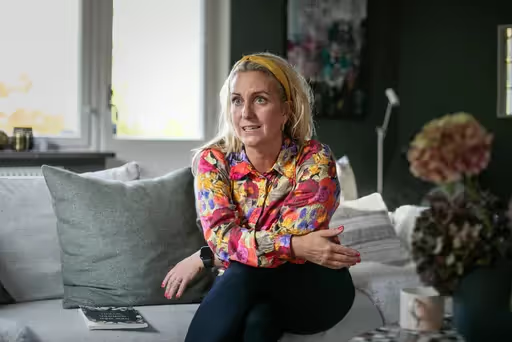
When Frida Hard lost her husband and was left alone with their one-year-old son, the world shook. It wasn't just a love she lost, it was a nuclear family, a vision of the future, an identity.
“It was like the ground was disappearing under me. In the midst of it, I realized how difficult it is for many to face grief. How little space it gets to take up in our society. How quiet it gets,” says Frida.
She began to notice what was missing. Not just support, but a place of grief. Utensils. Attendance.
“Many of us have never been taught how to deal with or face grief. Neither in school, in work, nor in everyday life. It's almost strange. For everyone has or/and will face grief. But we talk so little about it.”
Grief not only became a life-changing experience, it became a driving force. Frida wanted to change something. Make room for the missed conversations. For the feelings that were not expressed. For the quiet rooms where people carry on the difficult, completely alone.
She began to put into words recurring themes in the grief, themes rarely mentioned in superficial conversations: the fear, the anger, the loss of identity.
“I wasn't just sitting. I was angry. I was lost. I didn't recognize myself. A grieve came with so many fears I had to face: How would I cope financially? Was I enough as a mother? Would I ever feel happy again?”
Grief support: a place where grief is allowed to breathe
Six years ago Frida started Grief Support, a business where today she offers mourning circles, lectures, writing exercises and talks, for both individuals and companies.
“Getting to recognize yourself in other people's stories can be so healing. Sometimes we find it difficult to find our own words in grief. But when someone else says something we recognize ourselves in or that we feel completely different about, it can help us find our language, our words. And our new direction.”
Frida continues:”I want to be the voice that I myself lacked, one that says it's okay to feel exactly the way you feel and that all reactions are allowed to exist. If the grieve does not have the essence soaked or silenced, I am allowed to dry in your pocket. I want to be a safe hand to hold in grief.“