


.avif)
Where the practical and emotional meet in a conversation about life and death
Susanne LJ Westergren and Barbro Ohlson Smith come from completely different backgrounds but have found a common passion in opening up conversations about life's last journey. Where Susanne, with a, Barbro. Together they have created a platform where their complementary perspectives can meet and enrich each other.
Susanne: Think more about death and enjoy life
With a background as a nurse, and with experiences in hospice and emergency departments, Susanne has been close to both the beginning and the end of her life early on. In the middle of her life, she chose to train as a journalist with a focus on science and health. When she herself suffered bereavement in the family, she felt that she lacked both the knowledge and practical tools to deal with all that comes with death and grief. From that experience, the book grew The Art of Caring for an Estate ahead, and then the TV show on SVT Todo estado, in which the complex and often emotionally charged situations arising from a succession are portrayed.
For Susanne, practicality often becomes a way into the difficult, sorting, structuring and arranging. At the same time, she describes how she needs and longs to face the emotional deeper, and how order can sometimes become a refuge.
“For me, there is a spirituality that always accompanies every existence. I can see a soul in something as small as a bumblebee, and I carry care for every life, no matter how small,” after all, we are all part of a huge whole.”
Barbro: Designing the end
Barbro Ohlson Smith has a long background as a designer with a focus on identity and expression. Quando ha iniziato il podcast My death, my funeral it was to explore whether the same ideas about form and form could be applied to the end of life. She saw how many funerals followed a template and wondered if it was possible to create more personal farewells.
For more than fifty podcasts, Barbro.
“It has changed the way I look at the meaning of life and made me even more value living in the present, being present and taking advantage of relationships,” says Barbro about working on the podcast. Huh, and
The meeting point: the YouTube channel
When Susanne and Barbro found each other, a common idea emerged: to create a new forum where their different perspectives could meet. The result was a series on YouTube; How does it work - death, life and grief, which has recently been launched. vi. Also, how we can plan for the inevitable death of our own and those of our relatives is a topic that will be included in their productions.
Fact that they choose to broaden their collaboration with YouTube is because they want to reach out to younger generations. Moving media offers new possibilities for purely practical demonstration of how things work and not just tell about it. He, Jocke Wiik, sound engineer and film,.
Together they want to make it easier for us as a society to talk about death; not to set rules, but to dare to reflect, share experiences and perhaps find new ways to value life.
Ahead: more forums for talks
Both Susanne and Barbro see a continued need to create space for existential conversations. Through podcasts, books and now also the video format, they find different ways to reach out to more people. Needed for forums that open up conversations about death remains and Susanne and Barbro are far from finished.
Listen to Barbro's podcast My death, my funeral Aqui
Win YouTube Channel How does it work - death, life and grief Aqui

About Quality of Life
Having a stable financial situation and maintaining your health. Being in balance both physically and mentally. Laughing often and having kind people around you. Feeling that your life is generally good and doesn’t make you want to escape to a deserted island. These are some ideas of what quality of life can be.
From an academic perspective, quality of life is defined as a person’s subjective experience of their own well-being in relation to their life conditions. What quality of life actually means can vary between individuals and is influenced by factors such as environment, circumstances, and values. Because these aspects differ significantly from person to person, quality of life often becomes a philosophical question. The discussion can range from the most basic human needs to how we achieve self-actualization.
In societies where human rights are established and where strong social structures exist, conversations often revolve around how we can relax, enjoy life, and fulfill our dreams. However, many would generally agree that a good quality of life is characterized by a harmonious balance between physical, mental, economic, and social factors.
Quality of life is not static; it changes along with you and the society you live in. Today, we also encounter new types of factors that influence quality of life compared to the past. Work and leisure are increasingly intertwined, technology plays a major and central role in our lives, and social aspects have taken on new forms of distribution. All of this has both positive and negative effects. Therefore, the definition of quality of life is both fluid and constantly evolving.
It is thus a complex subject that touches on both individual and societal aspects. By understanding what affects it, we can improve our own quality of life and contribute to a better living environment for others.
Quality of life in healthcare
Quality of life is at the heart of healthcare. It is a very important aspect of treatment and care. It is, of course, important that a patient overcomes illness or receives the correct medical treatment, but how the individual’s daily life and well-being are affected by care is equally important. Quality of life in healthcare is therefore not only about curing diseases, but also about ensuring that patients can live as well and as independently as possible despite any health issues.
To safeguard quality of life in healthcare, the following are often prioritized:
- Access to fast and equitable care
- Maintaining high standards in pain management and symptom relief
- Providing psychological support to manage anxiety, depression, and other mental health challenges
- Encouraging patient participation in their care plan so they can have a say in the treatment they receive
- Palliative care – supportive care when a disease is incurable
Reduced quality of life
When life is marked by friction, or when a particular aspect becomes unbalanced, it can lead to a perceived decline in quality of life. For example, long-term stress, financial insecurity, social isolation, or chronic health problems can negatively affect a person’s well-being. People often feel that this limits their ability to do or achieve what they want. It can also mean restricted routines, a lack of routines, or a sense of losing control over one’s life.
To improve quality of life, it can therefore be important to identify and work on the areas that create imbalance—such as through support from healthcare services, social networks, or changes in lifestyle and daily habits.
If you would like to get in touch with a psychologist for professional help, you can make an appointment directly at Mindler.
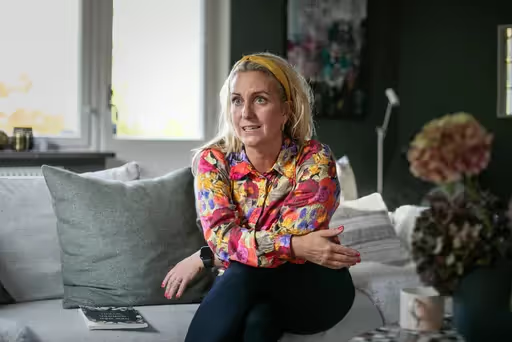
Making space for grief
When Frida Hard lost her husband and was left alone with their one-year-old son, the world shook. It wasn't just a love she lost, it was a nuclear family, a vision of the future, an identity.
“It was like the ground was disappearing under me. In the midst of it, I realized how difficult it is for many to face grief. How little space it gets to take up in our society. How quiet it gets,” says Frida.
She began to notice what was missing. Not just support, but a place of grief. Utensils. Attendance.
“Many of us have never been taught how to deal with or face grief. Neither in school, in work, nor in everyday life. It's almost strange. For everyone has or/and will face grief. But we talk so little about it.”
Grief not only became a life-changing experience, it became a driving force. Frida wanted to change something. Make room for the missed conversations. For the feelings that were not expressed. For the quiet rooms where people carry on the difficult, completely alone.
She began to put into words recurring themes in the grief, themes rarely mentioned in superficial conversations: the fear, the anger, the loss of identity.
“I wasn't just sitting. I was angry. I was lost. I didn't recognize myself. A grieve came with so many fears I had to face: How would I cope financially? Was I enough as a mother? Would I ever feel happy again?”
Grief support: a place where grief is allowed to breathe
Six years ago Frida started Grief Support, a business where today she offers mourning circles, lectures, writing exercises and talks, for both individuals and companies.
“Getting to recognize yourself in other people's stories can be so healing. Sometimes we find it difficult to find our own words in grief. But when someone else says something we recognize ourselves in or that we feel completely different about, it can help us find our language, our words. And our new direction.”
Frida continues:”I want to be the voice that I myself lacked, one that says it's okay to feel exactly the way you feel and that all reactions are allowed to exist. If the grieve does not have the essence soaked or silenced, I am allowed to dry in your pocket. I want to be a safe hand to hold in grief.“